Content strategy · 6 min read
The hidden cost of one-off content
Commissioning campaign by campaign looks cheaper than it is. Here's what one-off production actually costs, and why the price never appears on the invoice.
One-off content is the default almost everywhere, and it is easy to see why. A project has a brief, a budget, a start and an end. It can be approved by one person, measured against one number, and closed. Nobody has to defend an ongoing commitment.
It is also, in most cases, considerably more expensive than it appears.
The costs do not show up on the invoice. They show up as work that gets redone, value that gets left in the field, and a cost base that refuses to fall no matter how many projects you have already commissioned. It is the commonest form of a structural problem rather than a quality problem.
You pay for discovery every time
Every production engagement begins with the same work: understanding the business, the audience, the objection, the tone, the constraints, the stakeholders who need to approve things. On a one-off project, that work is absorbed into the project fee.
Then the project ends, and the understanding leaves with it.
The next project starts from close to zero. Not entirely — you keep the brand guidelines — but the accumulated context of how this organisation actually works is rebuilt each time, frequently by a different team. You are not buying a discount on the second project. You are buying the first project again.
This is the single largest hidden cost, and the easiest to miss, because it never appears as a line item. It is simply the reason the fourth project costs roughly what the first one did.
You capture one thing and leave the rest
A shoot day is a fixed cost — which is why an event can yield far more than a recap for the same money. The crew, the equipment, the location, the scheduling, the approvals, the travel — these are largely the same whether you leave with one deliverable or twenty.
What varies is how much you take away.
A team commissioned to produce a recap film will produce a recap film. They will not shoot the interview that would have made six months of short-form content, because nobody asked for it and it was not in the schedule. They will not capture the detail photography that a year of collateral would draw on, because stills were commissioned separately, or not at all. They will not structure the coverage so that it cuts three ways.
None of that is a failure of execution. It is a direct consequence of the brief. But the opportunity does not come back — the event happened once, the room was dressed once, the speakers were there once. Everything not captured is gone permanently, and re-creating any of it costs vastly more than capturing it would have.
You paid the fixed cost either way. The only question was how much you carried out.
Nothing compounds
This is the part that determines the trajectory.
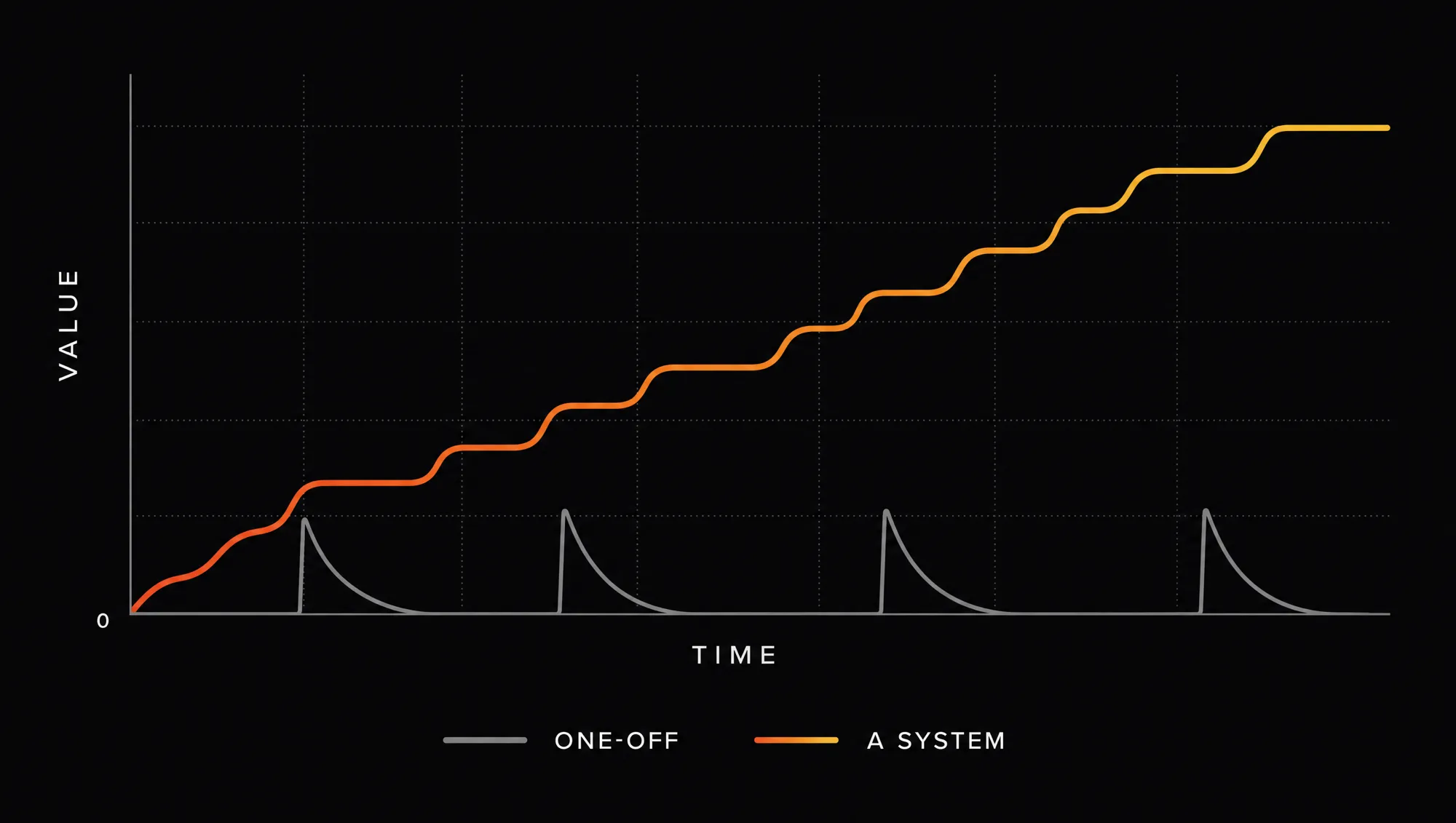
A one-off asset has a value roughly equal to what it cost, delivered mostly in the fortnight after it goes out, declining steadily afterwards. Commission four of those a year and you have four spikes that each fade. The line never rises.
A content system behaves differently, for unglamorous reasons:
- The footage library grows, so later projects start with material rather than nothing
- The audience understanding sharpens, so the work gets more accurate
- The production partner’s context deepens, so briefing gets faster and revisions fall
- Formats that worked become templates rather than fresh problems
None of that is exciting. All of it is cumulative. The result is that the tenth piece is cheaper to produce and more effective than the first, which is the only mechanism by which content ever stops being a cost centre.
The gap between the two lines is not visible in year one. It is very visible in year three.
The measurement problem
One-off content also makes itself hard to evaluate, which conveniently protects it from scrutiny.
A single asset can only really be measured by its own performance — views, engagement, maybe attributed enquiries. Those numbers tell you whether that piece landed. They cannot tell you whether content is working as a channel for the business, because a single asset is not a channel. It is one event.
So content stays in a permanent state of anecdotal assessment. The film did well. The photos were used. Everyone is satisfied and nobody can say whether it was worth it. Budgets survive on goodwill, which works until the year goodwill runs short.
Measurement requires a baseline and a series. One-off commissioning supplies neither — see measuring content that isn’t an advert.
What this does not mean
It does not mean one-off production is always wrong.
Some things genuinely are discrete. A single flagship film for a specific launch, a set of executive portraits, a one-time capture of a building before it changes — these are complete in themselves and there is nothing to compound.
The problem is not that one-off projects exist. It is that one-off commissioning is applied by default to work that was never discrete in the first place: the recurring event, the ongoing recruitment need, the constant demand for social content. That work is a system being handled as a series of emergencies.
The test is simple. Will you need something like this again within eighteen months? If yes, commissioning it as though you will not is the expensive choice, whatever the invoice says.
What it costs to change
Less than most organisations expect, because the shift is in how work is scoped rather than in how much is spent.
The same annual budget, committed as a programme instead of four separate projects, buys materially more: shared discovery, coverage designed for multiple uses, an asset library that belongs to you, and a partner who stops needing to be re-briefed. That is what the retained packages are structured around. The money is the same. The structure is different.
That is the entire argument. Not that you should spend more on content — that you are probably already spending enough, and paying for the same groundwork four times a year without realising it.